Inference
Coverage of three variance constructions for the cohort-matched estimator
The paper discusses three ways to compute standard errors for CM-CS. They differ in what they hold fixed:
| Construction | What it does | What it targets |
|---|---|---|
| Multiplier bootstrap (default) | One i.i.d. weight per unit on the influence function, as in the did package |
Treats units as independent; ignores the within-pair covariance |
| Matched-set clustered | One weight per matched pair, in the spirit of Abadie & Spiess (2022) | Unconditional variance; consistent for matching without replacement when matching discrepancies vanish (Abadie & Spiess 2022, Prop. 5) |
| Joint bootstrap | Resample units, re-match, re-estimate | Unconditional variance, re-drawing the matches in every replication |
The results below come from 300 Monte Carlo replications per design, with the overall ATT of CM-CS as the target. They describe the designs we simulate; they are not general results.
Warning
Correction (October 2026). An earlier version of this page reported that matched-set clustering under-covers, by a margin that did not shrink with sample size. That result came from how the did package scales clustered bootstrap standard errors when clusters differ in size. The unmatched never-treated units entered as one-unit clusters next to the matched pairs, and this shrank the clustered standard error at every sample size. The results presented in the current version drop the unmatched units before estimation. This changes no point estimate and no default standard error.
Coverage
In these designs:
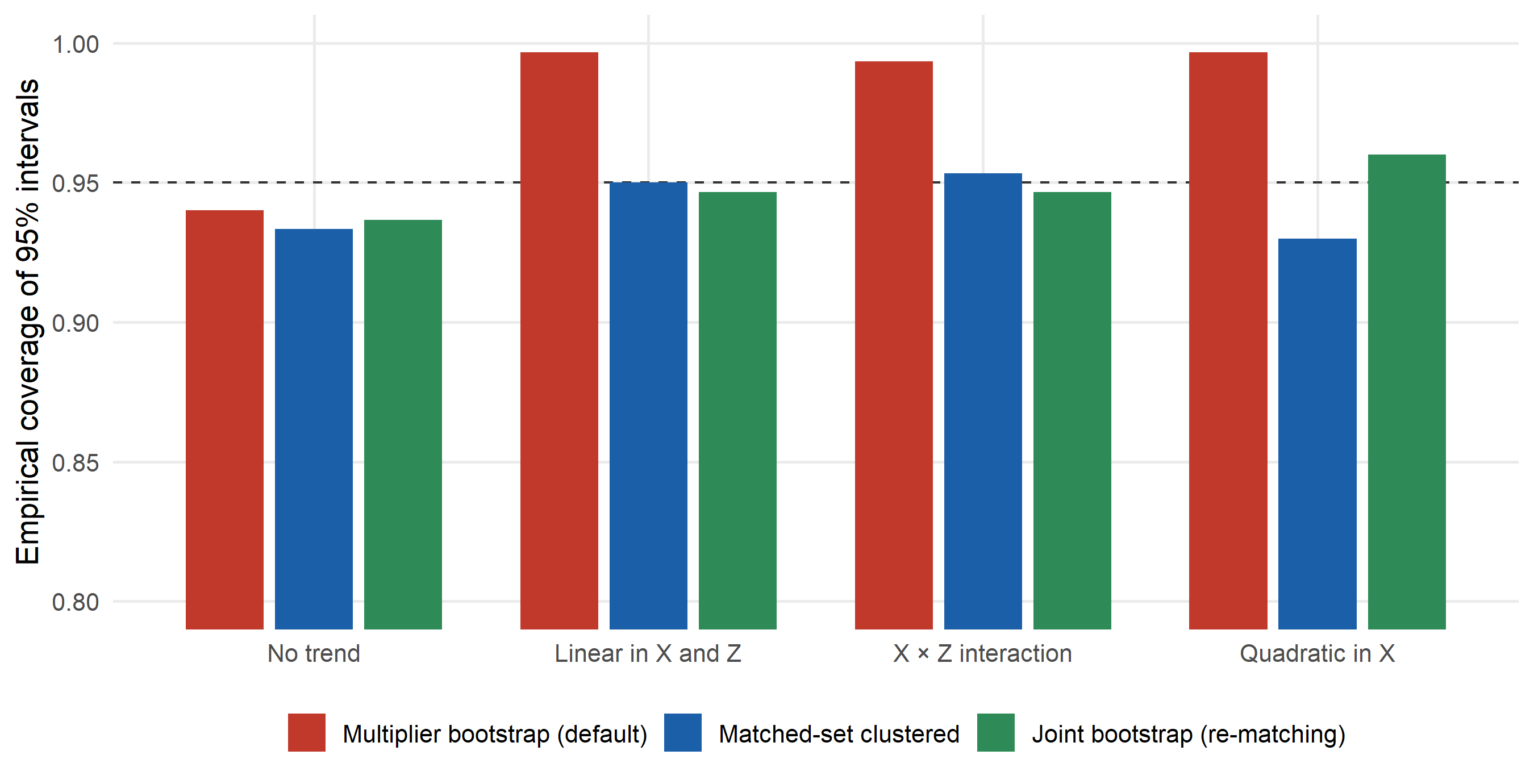
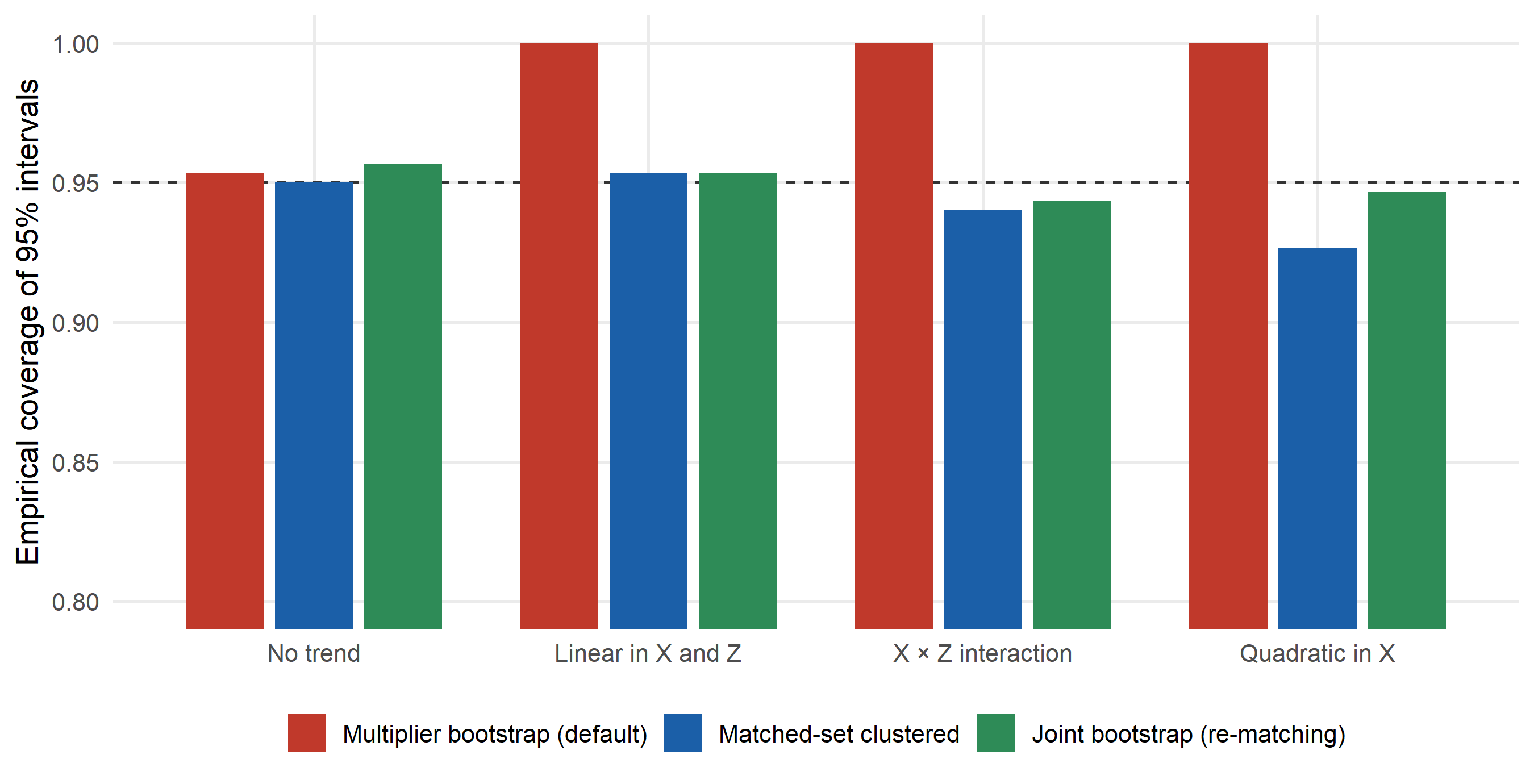
- The default bootstrap is close to nominal when parallel trends hold unconditionally. It over-covers once trends depend on the covariates. Matched pairs co-move through their common trend, the within-pair covariance of the influence functions is negative, and ignoring it overstates the variance.
- Matched-set clustering restores that covariance and is close to nominal coverage in every design (0.93–0.95).
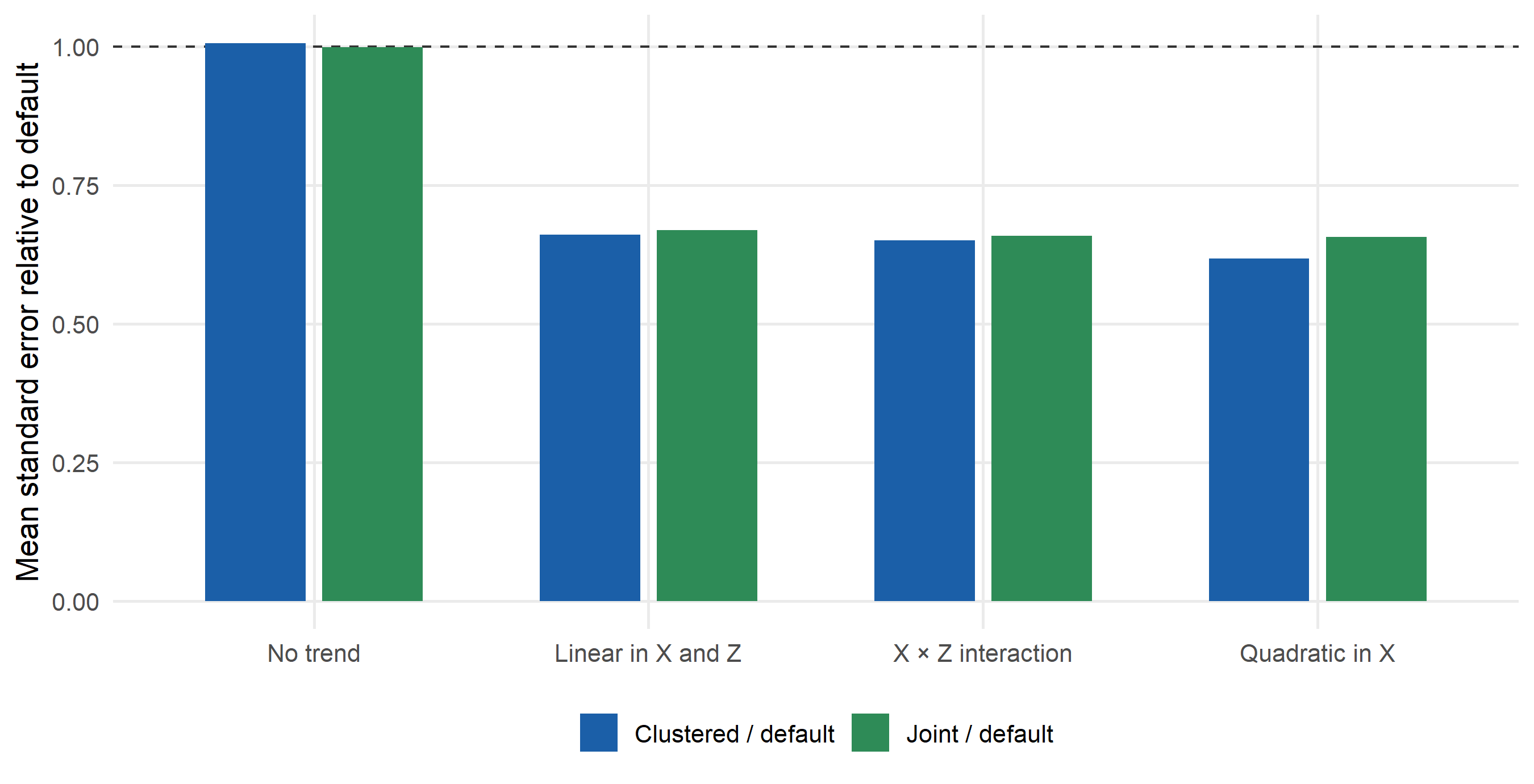
- The joint bootstrap repeats the matching in every replication and is also close to nominal (0.94–0.96). Its standard errors are within 7% of the clustered ones. So in these designs the variability from selecting the matches is largely captured by clustering on the realized pairs, as the theory for matching without replacement predicts.
Standard errors
Note
In the empirical application the paper reports the multiplier bootstrap clustered at the pre-displacement firm. A treated worker and the matched control are generally employed in different firms, so this construction also omits the within-pair covariance, which on its own makes it conservative in the designs above.