Matched difference-in-differences with staggered treatment
Companion website to Cuzzola & Tiedtke (2026), Not All Scars Are Equal: Job Loss Along the Wage Distribution
The problem
Matched difference-in-differences designs are the workhorse of the job-displacement literature: each displaced worker is matched to similar non-displaced workers before displacement, and effects are estimated on the matched sample. With staggered treatment, the matched controls of one cohort were chosen to resemble that cohort, not the others. Standard estimators applied to the pooled matched sample nonetheless compare each cohort with every cohort’s matched controls, which reintroduces the cross-cohort imbalance that matching was meant to remove.
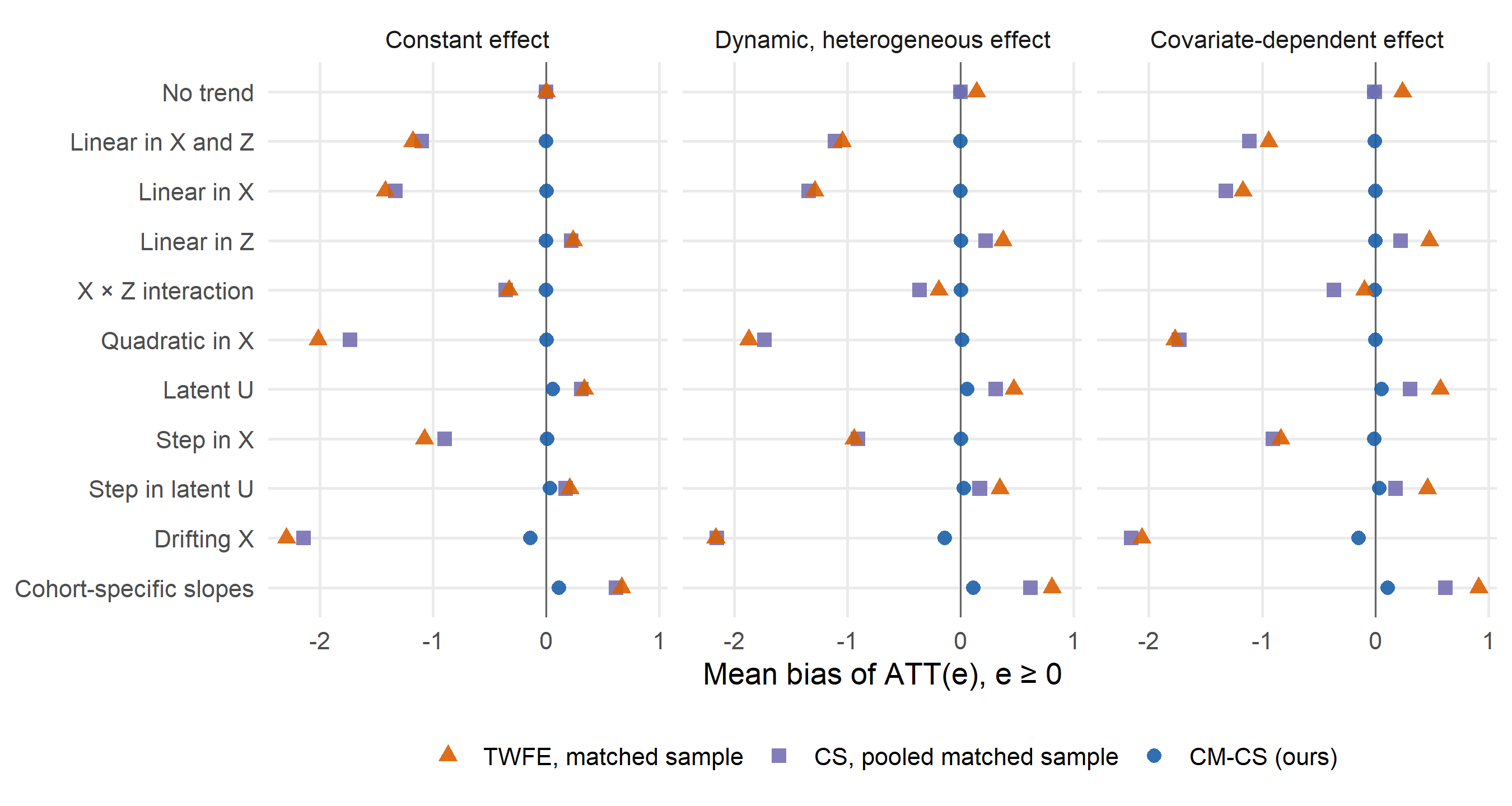
This site collects the Monte Carlo evidence behind the estimator proposed in the paper. It compares three ways of estimating event-study effects on a matched sample:
| Estimator | Comparison group for cohort \(g\) |
|---|---|
| TWFE, matched sample | All other units in the matched sample: own and other cohorts’ matched controls, not-yet-treated and already-treated units |
| CS, pooled matched sample | Callaway & Sant’Anna (2021) with every matched control treated as never-treated |
| CM-CS (ours) | Only the never-treated units matched to cohort \(g\) itself |
Headline result
Once untreated outcome trends depend on the matching covariates, applying CS or TWFE to the pooled matched sample is biased, even though every treated unit has a close match. Restricting each cohort to its own matched controls (CM-CS) removes this pooling bias. TWFE is additionally biased when effects differ across cohorts, even without any trend. A small bias remains for CM-CS only when trends are driven by characteristics that matching on the observed covariates cannot balance.
Where to go next
- Simulation design: the data-generating process, the trend designs and the matching scheme.
- Results: event-study plots and bias tables for the three estimators, three treatment-effect patterns and eleven trend designs.
- Matching vs. conditioning: when conditional parallel trends with covariate adjustment delivers the same answer, and where it breaks down.
- Inference: coverage of the three variance constructions discussed in the paper.
- Implicit weights: which \(2\times2\) comparisons each estimator averages over.